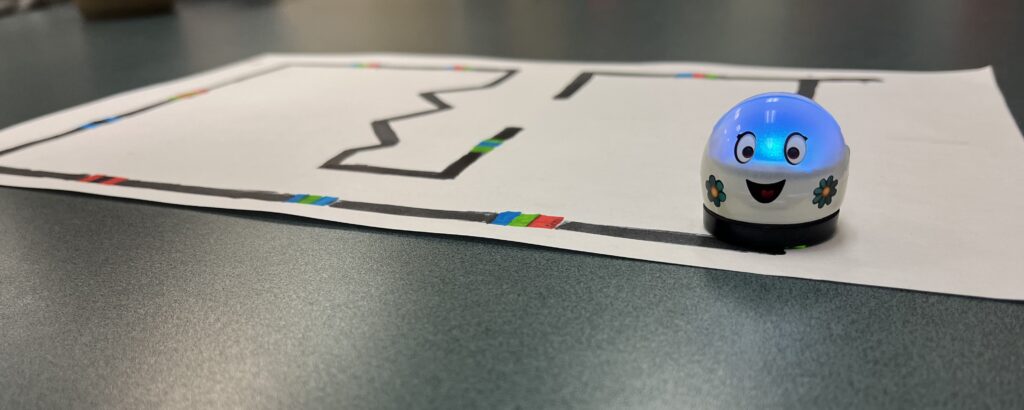
Learning ultimately supports the well-being of the self, and family, the community, the land, the spirit, and the ancestors… This principle applied to our activity with the Ozobots through our appreciation to live in the moment with these tiny, cute robots. I went home after this class and told my family about working with the Ozobots, my whole family enjoyed hearing the story and watching the videos I had taken. The experience was something so simple and unique it brought joy to myself and the people I shared the experience and my stories with.
Learning is holistic, reflexive, reflective, experiential, and relational (focused on connectedness, on reciprocal relationships, and a sense of place)… This principle applied to our activity with the Ozobots through reflecting back on how the experience felt. I was able to connect with a classmate I had not had a ton of interactions with previously which I was grateful for. I likely would have not gotten the opportunity to connect with this classmate and build a reciprocal relationship without doing this activity with the Ozobots.
Learning involves recognizing the consequences of one’s actions… This principle applied to our activity with the Ozobots because every move you made from calibrating the Ozobot to coding a path for the Ozobot was in direct response from the actions me and my partner made. Not all actions worked out the first try or even the second but with working as a team we came up with a good end result.
Learning involves generational roles and responsibilities… This principle applied to our activity with the Ozobots through me and my partner both growing up through the school system at different points in time, and therefore, having different and varying knowledges about the activity. We were appreciative to hear and use each others different experiences and point of views when carrying out the activity.
Learning recognizes the role of Indigenous knowledge... This principle applied to our activity with the Ozobots because it could be applied and recognize Indigenous knowledges through appreciation of our opportunity to even do the activity. Everyone in the class had so much fun coding with the Ozobots, we would not have gotten to be able to do this with acknowledging our appreciation for the unseeded territory we are on at the University. The Ozobots embraced our gratitude to be in this education program and learning in such a fun environment which would not be possible without acknowledging Indigenous peoples and knowledge.
Learning is embedded in memory, history, and story... This principle applied to our activity with the Ozobots as this memory of working with them was so original for both me and my partner that it is not an experience we will soon forget. Its important to me as an educator to give my students memorable experiences so they have stories to tell one day about that time they worked with tiny robots in class with their friends, and that is exactly what this activity provided.
Learning involves patience and time... This principle applied to our activity with the Ozobots because there was a bit of a learning curve to working with the Ozobots, me and my partner had never worked with these little robots prior, nor had we been exposed to the codes we used. This made for one another being patient with each other as we figured out how to use them at our own pace.
Learning requires exploration of one’s identity... This principle applied to our activity with the Ozobots through identifying the different tendencies I had versus my partner in the activity and even the other groups performing the exercise. The path I wanted to code was a very different path then my peers created. While making our own codes with my partner I was quicker to jump ahead and get working on my free had path, while my partner was more comfortable staying with the formatted path for a while before joining me to create our own path. This help me explore my identity in a way of seeing how I work differently from others on the same task. No one way was better, and we got a good result, but our approaches were different.
Learning involves recognizing that some knowledge is sacred and only shared with permission and or in certain situations... This principle applied to our activity with the Ozobots through respecting one another’s boundaries. We asked one another before writing new codes down for our Ozobot, we made sure each other was on the same page with any moves made, and we were understanding with each others wish to show a certain coding path for the whole class to see.